Mines at Zora: stake, reveal and collect are separate decisions
In a Mines-style instant game, choosing the board settings is different from deciding whether to reveal another square. Identify the exact Zora-listed title and read how the mine count changes the displayed multiplier schedule. A familiar grid does not guarantee familiar rules.
Before starting, locate the stake and the collect control. Confirm whether the screen is showing a prospective multiplier or an amount that can actually be collected from the active round. If a display says 2× at a €1 stake, inspect the rules to see whether €2 is the total return rather than €2 profit. Do not add the original stake twice.
Each additional reveal exposes the current round to another losing outcome. Past boards do not provide a safe map for the next board. A pattern that worked previously is not evidence that the same squares will remain safe, and increasing the stake after a loss does not change that uncertainty.
If the connection drops, use round history to establish whether the last action was accepted before repeating it. A frozen screen is not proof that the round was cancelled. Keep the round reference and selected settings for support; avoid trying to reproduce the issue through more paid rounds.
Label each stage of a round before using the controls
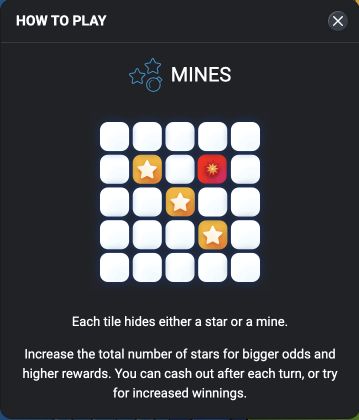
A Mines-style interface usually separates a starting configuration from an active board, but the exact implementation must explain when the stake becomes committed. Locate the control that starts a paid round, the controls that reveal cells and the action that completes collection. These are different instructions even if they appear close together on a small screen.
The distinction is particularly important after returning from another app. A visible grid could be a finished board, an active board or a fresh configuration. Check the round status before deciding what the next tap will do. An apparently empty square is not sufficient evidence that no money is currently at risk.
A probability example needs explicit assumptions
Consider a fictional board with twelve equally likely cells containing three hazards, where safe cells are removed from further selection. Under those assumptions, the first safe reveal has probability nine out of twelve. After one safe reveal, the next safe reveal has probability eight out of eleven. The probability of both is their product, about 54.55%. This is an explanatory model, not verification of Zora's board generation or configuration.
The example shows why a successful reveal does not make the next reveal certain. It also does not establish a fair payout or a recommended stopping point. The actual multiplier schedule and game rules are separate information that must be read rather than inferred from the grid alone.
Keep the collectable amount separate from the next possible amount
Some interfaces can display both the amount associated with the current state and a prospective amount for another successful reveal. Identify which is which before comparing them. A larger future label is conditional on a result that has not occurred. It is not money already added to the account.
In a hypothetical €2 round, a current total-return amount of €3 means a potential net result of €1 if collection is accepted under the rules. A prospective €4 label for another reveal does not make the current result €4. Read the accepted collection record rather than the largest visible number.
Record an interruption without replaying the decision
For a frozen active board, retain the round reference, stake, selected hazard count and last action whose acceptance is certain. After reconnecting, compare those details with the game history. The question is whether the last reveal or collection was recorded, not whether a new board looks similar.
Do not reconstruct the round from a remembered pattern of safe squares. A screenshot can help identify the state but does not prove the server accepted an unconfirmed click. If the outcome remains unclear, stop using the board and ask support about that round. Starting another one introduces a separate paid event without resolving the first.